
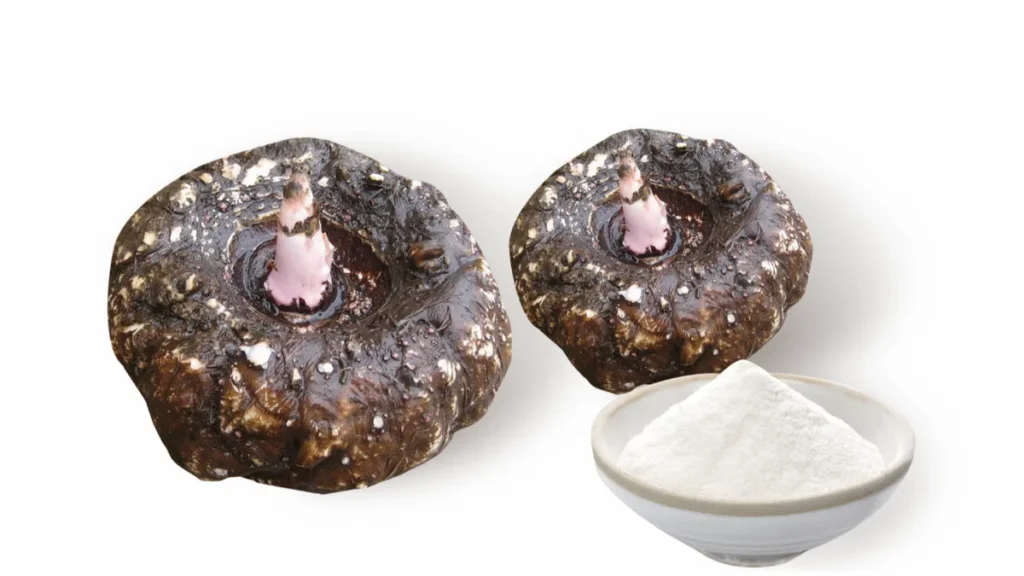
Konjac gum, primarily associated with konjac glucomannan, is a highly hydrophilic food hydrocolloid. It is used to build viscosity, manage water and support structured systems, but its performance depends heavily on dispersion and processing. The same grade can give different results when the concentration, temperature, pH, solids content or companion hydrocolloids change. Formulators should therefore treat konjac as part of a system rather than as a universal thickener.
Water absorption drives both functionality and processing risk
Konjac gum has a strong affinity for water. As the polymer hydrates, it can produce substantial viscosity and reduce the mobility of the aqueous phase. This property is useful for moisture control, body and suspension, but rapid surface hydration can also create lumps if the powder is added directly without adequate dispersion.
Dry blending with another powdered ingredient, controlled addition into a strong vortex, or pre-dispersion may be considered depending on the formula and equipment. The objective is to separate particles before they swell. Sugar, salt, starch and proteins compete for available water, so an addition method that works in plain water may not transfer directly to a commercial recipe.
Thickening and suspension depend on concentration and shear
Konjac can increase continuous-phase viscosity, helping slow the movement of fruit particles, spices or other inclusions. The required flow behavior must match both processing and consumption. A beverage or sauce may need enough low-shear viscosity to support particles while remaining pumpable and easy to pour.
Concentration should be screened carefully rather than selected from a generic dosage statement. Small formulation changes can alter perceived body and adhesiveness. High shear may improve dispersion but can also change the way the hydrated system develops. Viscosity should be measured at relevant temperatures and shear conditions, not only after the sample has rested.
Gel formation changes with pH, temperature and treatment
Konjac glucomannan can participate in different gel structures. Under suitable alkaline conditions it can form a heat-stable network, while combinations with other hydrocolloids can create synergistic gels through polymer interactions. These routes produce different textures and should not be described as one mechanism.
Temperature affects hydration and the development of companion ingredients. pH can influence stability and the conditions required for structure formation. In acidic fruit systems, for example, the order and duration of heating deserve attention. A useful trial follows the intended process from mixing through filling, cooling and storage.
Konjac interacts with other hydrocolloids
Konjac is frequently evaluated with carrageenan or other gums when a single polymer does not provide the desired combination of viscosity, elasticity and water control. Synergy may allow the texture to change more than expected from simply adding the individual effects. It can also produce an unsuitable gel if the ratio or ionic environment is wrong.
For this reason, blends should be designed around a target texture. A jelly may require elastic recovery and clean release, while a meat system may prioritize moisture, firmness and bite. A frozen product may require stability through temperature cycling. The DEHUI konjac gum page provides the product-family context for these discussions.
Applications require different functional priorities
In jelly and soft candy, konjac may contribute chew, elasticity and moisture control, often as part of a compound gelling system. In meat products, it may support water management and texture alongside protein, salt and other binders. In frozen foods, the focus may be on controlling free water and maintaining structure through processing and storage.
Flour-based foods introduce interactions with starch and gluten, while fruit paste combines acidity, sugar and suspended solids. Film-forming behavior may be relevant to coatings or structured matrices. These examples show why the term “konjac application” is too broad without the finished-product details available on the application fields page.
Evaluate konjac in the complete manufacturing sequence
A practical trial records powder dispersion, hydration time, temperature, pH and the point at which other solids are added. Samples should be compared for viscosity, suspension, water separation, gel texture and mouthfeel. Where the product is frozen, heated or stored for an extended period, the relevant cycle should be included.
Konjac selection is most reliable when the required function and process limitations are stated clearly. R&D and procurement teams can review the available manufacturing and quality framework and provide the formula context through the DEHUI contact page.
Frequently Asked Questions
What is konjac gum used for in food?
Konjac gum is evaluated for thickening, water management, suspension, gel development and film-forming behavior. Applications include jelly, soft candy, meat products, frozen foods, flour-based foods and fruit preparations, subject to the complete formula and process.
Why is konjac gum hydration important?
Konjac gum absorbs water rapidly. Poor dispersion can create lumps with dry centers, while competition from sugar, salt or other ingredients may slow hydration. Addition order, shear, available water and temperature should be controlled.
Does konjac gum form a gel by itself?
Konjac glucomannan can form structured systems under suitable conditions, including alkaline treatment, and it can interact synergistically with other hydrocolloids. The relevant mechanism depends on the food product and must be confirmed by application testing.
Can konjac gum be combined with carrageenan?
Yes, konjac and carrageenan are often evaluated together because their interaction can modify gel strength, elasticity and water management. The outcome depends on gum type, ratio, ions, pH and processing conditions.