
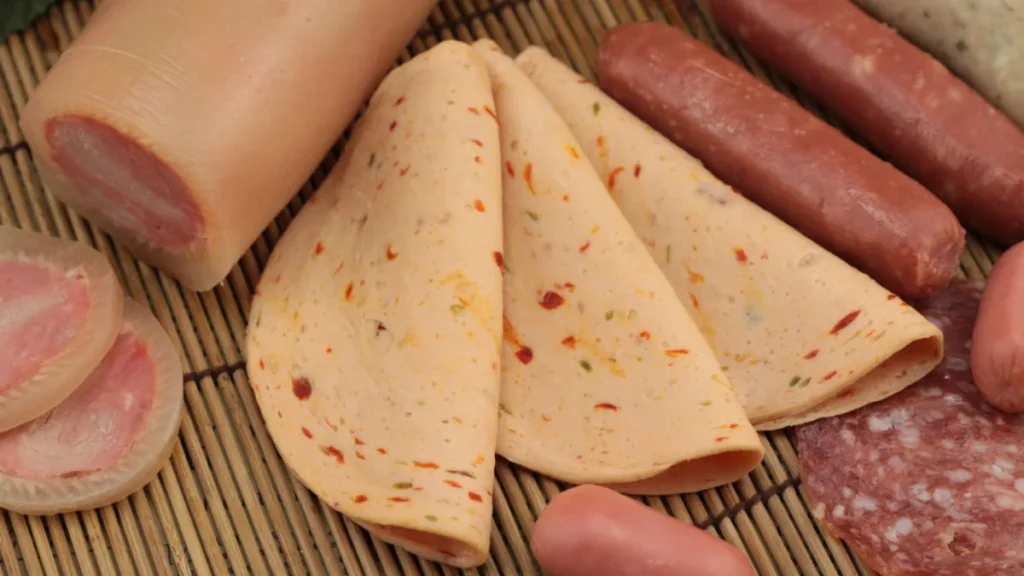
Carrageenan is used in processed meat formulations because it can contribute to moisture management, texture and structural stability. Its value is not based on one isolated property. During chopping, mixing, heating and cooling, carrageenan becomes part of a wider matrix that includes extracted meat proteins, water, salt, fat and other functional ingredients. Understanding that matrix is essential when the targets include firmness, sliceability, reduced purge or a more consistent bite.
Carrageenan supports structure through the complete process
Processed meat texture develops as salt-soluble proteins are extracted, dispersed ingredients are incorporated and the system is heated. During cooling, proteins and hydrocolloids contribute to the final network. Selected carrageenan systems can increase the ability of that network to immobilize water and maintain a cohesive structure.
This behavior can be relevant in sausages, formed products, deli-style items and other comminuted or restructured foods. The desired result is not simply maximum hardness. A useful formulation balances firmness with elasticity, juiciness, slice integrity and a mouthfeel appropriate to the product category.
Water retention depends on more than the hydrocolloid
Carrageenan is hydrophilic, but moisture retention in meat cannot be understood by looking at carrageenan alone. Protein quality and extraction determine how effectively the meat matrix binds water. Salt level affects protein solubilization. The ratio of added water to protein changes the load placed on the stabilizing system. Fat distribution and particle size also influence the physical structure.
For this reason, two formulations using the same carrageenan can behave differently. One may show good cohesion and limited purge, while another may remain weak because the protein network, mixing sequence or thermal treatment is different. A technical review should therefore begin with the full formula and process rather than a single ingredient specification.
Firmness and sliceability require a controlled network
Sliceability is a practical test of structural integrity. A product must resist crumbling, smearing and surface water while remaining acceptable to eat. Carrageenan may help reinforce the cooled matrix, but excessive or poorly balanced structure can create brittleness or an artificial bite.
The target should be expressed in product terms: clean slicing at a defined temperature, sufficient firmness for packaging, or elasticity during consumption. Those targets guide the choice of carrageenan type and whether a carrageenan product should be evaluated alone or with another stabilizer.
Salt, phosphates and other stabilizers change performance
Salt has several roles in a meat system, including protein extraction and flavor. It also changes the ionic environment in which carrageenan hydrates and gels. Phosphate systems can influence pH, ionic strength and protein functionality. Starches, proteins, fibers and other hydrocolloids compete for water and contribute their own viscosity or gel behavior.
These interactions explain why a carrageenan result cannot be transferred automatically from one formula to another. The addition of a phosphate, a change in salt, or replacement of part of the meat protein may require the hydrocolloid system to be rebalanced. For phosphate-free development, citrate and hydrocolloid combinations may be explored, but they should be treated as a new system rather than a direct one-for-one substitution.
Heating and cooling determine the final texture
Processing temperature affects protein denaturation, carrageenan solubilization and the sequence in which the network develops. Insufficient heating may limit functionality. Excessive processing or an unsuitable hold can change water distribution and texture. Cooling is equally important because the final gel structure develops as temperature falls.
Application trials should reproduce the plant profile as closely as possible, including chopping temperature, mixing time, cook schedule, filling format and cooling rate. Samples should then be assessed for cook loss, purge, firmness, elasticity, sliceability and mouthfeel. The DEHUI application overview provides additional context for meat-product discussions.
Build the test plan around the product target
A focused evaluation records the protein source, fat level, added water, salt, phosphates or citrate, other stabilizers and the required label strategy. It then compares candidate carrageenan systems under the same process. Changes should be made systematically so that differences in texture and moisture can be attributed to the formulation rather than uncontrolled processing variation.
The result should be a technically balanced system, not the highest possible viscosity in water. Buyers and R&D teams can use the capabilities and quality information when reviewing supplier documentation, then share the actual formulation context through the DEHUI contact page.
Frequently Asked Questions
What does carrageenan do in meat products?
Carrageenan can support water binding, gel structure, firmness and sliceability in processed meat systems. Its effect depends on the carrageenan type and on the protein, salt, water, heating and cooling conditions used in the complete formulation.
Does carrageenan help with water retention?
Carrageenan is hydrophilic and can contribute to a network that manages moisture during processing and cooling. It should not be evaluated as an isolated water binder, because protein extraction, phosphate or citrate systems, mixing and thermal history also influence retained water.
What factors affect carrageenan performance in meat?
Important variables include meat protein content, salt level, added-water ratio, carrageenan type, dispersion method, heating profile, cooling rate and interactions with phosphates, starches, proteins or other stabilizers.
Should carrageenan be dry blended or pre-dispersed?
Both approaches can be technically possible, but the best method depends on equipment and formula design. The goal is uniform distribution without lumping or premature hydration. Plant trials should confirm which addition sequence provides consistent performance.