
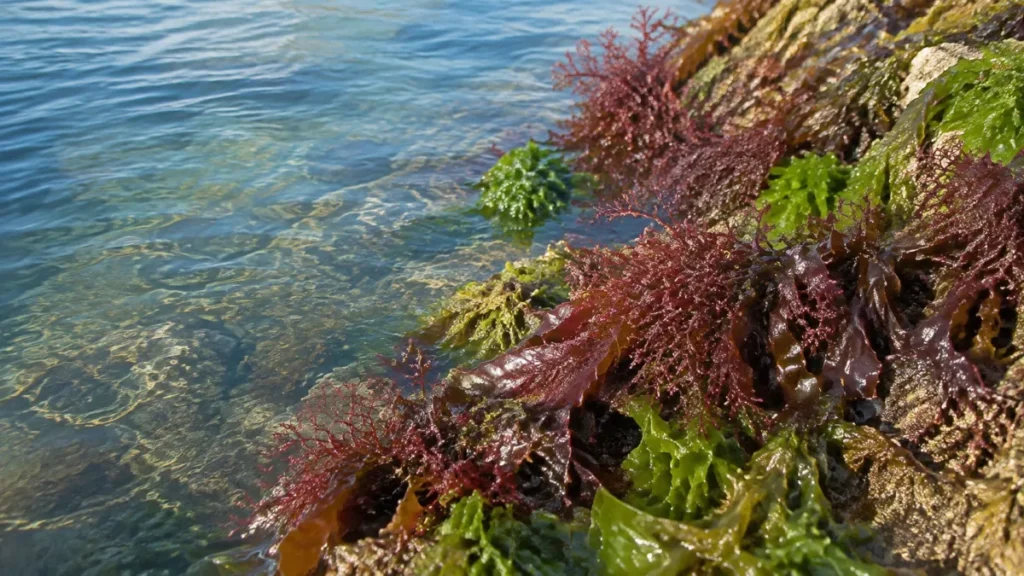
Agar agar and carrageenan are both seaweed-derived hydrocolloids, but they are not interchangeable ingredients. Their molecular structures, gel mechanisms and responses to processing create different textures in finished foods. A comparison therefore needs to move beyond origin and examine how each material behaves in water, in the complete formulation and through the required heating and cooling cycle.
Both come from red seaweed, but they are different materials
Agar and carrageenan are extracted from different groups of red algae and contain different polysaccharide fractions. Agar is associated with agarose-rich systems that form gels as heated solutions cool. Carrageenan includes several functional types, commonly described as kappa, iota and lambda, with different degrees of sulfation and different responses to ions.
That family distinction is important. It is misleading to compare one agar grade with “carrageenan” as if every carrageenan behaves the same way. Kappa carrageenan is commonly associated with firm gels under suitable conditions, iota with more elastic structures, and lambda with thickening rather than gelation. The supplier grade and intended application must be identified before a useful comparison can be made.
Gel texture is usually the clearest practical difference
Agar is often selected when a firm gel with a relatively clean, brittle fracture is desired. This can be useful in gelled desserts, confectionery and other products where shape retention and a distinct break are part of the sensory target. The gel can form at a different temperature from the temperature required to dissolve the ingredient, creating useful thermal behavior in some processes.
Carrageenan offers a wider range of textures because its major types behave differently. A kappa-dominant system may provide a firmer, more brittle structure, while iota systems can produce a softer and more elastic gel. Lambda carrageenan contributes viscosity without forming a conventional gel. The correct comparison is therefore between the target texture and a specific functional grade.
Processing behavior affects equipment and product consistency
Both ingredients require controlled dispersion to prevent lumping and uneven hydration. Heating is commonly used to dissolve and activate the hydrocolloid, but the required conditions depend on grade and formulation. Sugar, salts, acids and other solids can alter hydration and gel development.
A process review should include powder addition, shear, heat-up rate, hold time, filling temperature and cooling. If an ingredient begins to structure too early, filling may become difficult. If dissolution is incomplete, the final product may contain weak areas or particles. Pilot work should reproduce the intended plant sequence rather than relying only on a small beaker test.
Water management depends on the food matrix
Hydrocolloids interact with water, but they do not all manage water in the same way. Agar builds a three-dimensional gel network that immobilizes water within the structure. Carrageenan can contribute gelation, viscosity and water control, and selected systems interact with proteins and ions in ways relevant to dairy, meat and other formulated foods.
Syneresis should be evaluated over the expected storage period and temperature. A strong initial gel can still release water if the network contracts or the formulation is poorly balanced. Soluble solids, acidity, mineral content and other gums can change that behavior. Water retention claims should therefore be based on the real formulation and storage test.
Typical applications overlap, but the selection logic differs
Agar agar is frequently considered for firm gelled foods, confectionery, bakery-related systems and microbiological or technical uses where its gel characteristics are appropriate. Carrageenan is widely evaluated in meat, dairy, plant-based, gelled and thickened systems where interactions with water, proteins and ions can be useful.
Application names do not make the final decision. Two jellies may require very different fracture and elasticity. Two processed meats may contain different proteins, salts and water ratios. Selection should be based on the required texture, process and ingredient environment described in the application context.
Choose by formulation requirement, not by a better-or-worse ranking
Agar is not universally better than carrageenan, and carrageenan is not universally more versatile for every product. Agar may be the more direct starting point for a firm, clean-breaking gel. A selected carrageenan may be more suitable where elasticity, protein interaction, ion-responsive gelation or thickening is central. In some cases, a blended system may create the most useful balance.
R&D teams should define the target texture and process, shortlist appropriate grades, and compare them under controlled conditions. Supplier review can then consider specification and documentation alongside application performance. Questions about grade selection can be shared through the DEHUI technical enquiry channel.
Frequently Asked Questions
Is agar the same as carrageenan?
No. Both are hydrocolloids obtained from red seaweeds, but they contain different polysaccharide structures and produce different functional behavior. Their gel texture, response to ions and use conditions should be compared in the finished formulation.
Which forms a stronger gel, agar or carrageenan?
There is no universal answer because strength depends on grade, concentration, salts, solids, pH and test method. Agar often forms a firm, brittle gel, while selected carrageenan types form firm or elastic gels under suitable ionic conditions.
Can agar and carrageenan be used together?
They can be evaluated together when the formulation needs a texture that neither material provides alone. The blend ratio, hydration process, ionic environment and other ingredients determine whether the combination is technically useful.
Which is better for water retention?
Water management must be assessed in the complete food matrix. Carrageenan is often considered in protein and moisture-control systems, while agar is frequently selected for gel structure. Product composition and processing determine the better fit.