
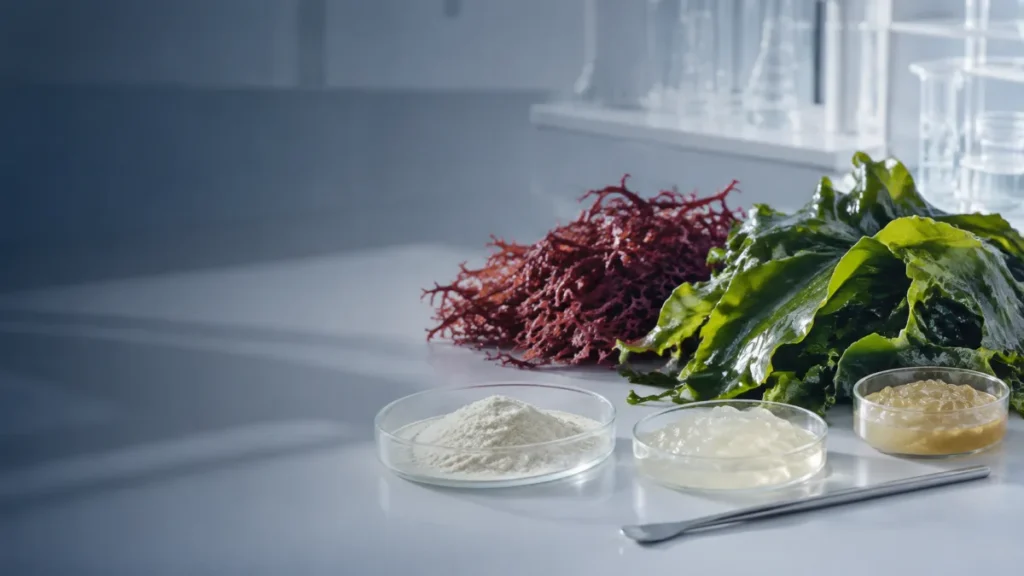
Choosing a food hydrocolloid is not simply a matter of matching an ingredient name to an application. Carrageenan, agar agar and konjac gum can all influence viscosity, gel structure and water management, yet they respond differently to heat, salts, pH, proteins and other formulation components. The correct choice starts with the finished-product target and the actual manufacturing process, not with a generic statement that one gum is stronger or more effective than another.
Start with the texture the finished product must deliver
The first question is what the consumer should experience. A clean-cut jelly, an elastic gel, a spoonable sauce and a sliceable processed food require different structures. Gel strength alone does not describe those differences. Fracture behavior, elasticity, adhesiveness, water release and recovery after deformation all contribute to perceived texture and mouthfeel.
Agar agar is commonly considered where a firm gel with a clear break is required. Carrageenan is a family rather than one uniform material: different carrageenan types can provide firm gelation, elastic gelation or thickening, depending on the formulation and ionic conditions. Konjac gum is highly hydrophilic and can support thickening, water control and, under suitable conditions or in blends, structured gel systems. These distinctions make application targets more useful than product labels.
Compare the primary functions before comparing grades
A practical selection process separates the job into functional priorities. The same formula may need more than one of them, but identifying the dominant requirement helps narrow the starting options.
- Gel formation: define firmness, elasticity, fracture and the temperature at which the structure must remain stable.
- Thickening: consider the required flow at rest, during pumping and during consumption.
- Water retention: assess whether the system must reduce purge, control syneresis or retain moisture through heating, cooling or storage.
- Mouthfeel: determine whether the target is clean, creamy, elastic, short, cohesive or another specific sensory profile.
The DEHUI product overview provides a starting point for comparing the available natural gum families, while the application fields page shows how those functions connect to finished-product requirements.
Processing conditions determine whether hydration succeeds
Hydrocolloids only deliver their intended function when they are dispersed and hydrated correctly. Processing temperature, available water, shear, mixing order and residence time can change the result. A powder that forms lumps or hydrates before it is evenly dispersed may create inconsistent viscosity and localized gel particles. Conversely, insufficient heat or hydration time may leave part of the material underdeveloped.
For heat-set and heat-solubilized systems, the full time-temperature profile matters: initial mixing, heating, holding, filling and cooling. For cold-process systems, dispersion strategy and competition for water become especially important. Sugar, starch, protein, salt and other soluble solids may reduce the water immediately available to the gum. Selection therefore needs to reflect the real process rather than an isolated water test.
Evaluate pH, ions and ingredient compatibility
Food formulations are chemically complex. pH can influence polymer stability, hydration and interactions during processing. Minerals and salts may promote or modify gel formation in certain carrageenan systems, while high ionic strength can also change the rate at which a gum hydrates. Protein surfaces, starch gelatinization and emulsified fat introduce additional interactions.
Compatibility should be reviewed across the complete ingredient list. A hydrocolloid may perform well alone but produce a different texture when used with protein or another gum. That difference is not necessarily negative: controlled interactions are often the reason compound systems are used. It does mean that supplier comparison should include application behavior, not only a certificate of analysis.
Consider stability beyond the first production day
Immediate viscosity or gel strength is only one part of product performance. The formulation may also need to tolerate pumping, filling, retorting, chilled distribution, freezing and thawing, or repeated temperature changes. Water migration and syneresis can appear after processing even when the initial sample looks acceptable.
Freeze-thaw stability is especially formulation-specific. Ice formation concentrates dissolved components and can damage weak networks. A useful evaluation therefore compares samples after the actual storage cycle, with attention to water separation, texture recovery and sensory changes. Similar thinking applies to hot filling and thermal processing: the hydrocolloid must fit the sequence of stresses the product will experience.
Use a formulation-led selection workflow
A productive technical discussion begins with the finished product, target texture, process, pH, salt system, storage condition and label constraints. Candidate gums can then be screened for dispersion, hydration and initial functionality. The most promising options should be tested in the complete formula and under representative processing conditions.
This workflow avoids the common mistake of treating a hydrocolloid as an isolated specification. It also creates a clearer basis for deciding whether carrageenan, agar agar, konjac gum or a compound system deserves further testing. DEHUI can support that discussion with product information and application context through its technical contact channel.
Frequently Asked Questions
Which hydrocolloid should be selected for a firm gel?
The answer depends on the desired fracture, elasticity, serving temperature and ionic environment. Agar often produces a firm, relatively brittle gel, while selected carrageenan types can form firm or elastic gels under suitable salt conditions. Bench testing in the complete formulation is essential.
Can one hydrocolloid provide both thickening and water retention?
A single hydrocolloid may contribute to both functions, but the balance is formulation-dependent. A material that builds viscosity in water may behave differently in a protein-, sugar- or salt-rich system, so hydration and finished-product testing should be evaluated together.
Why does processing temperature matter when choosing a hydrocolloid?
Temperature controls dispersion, hydration and gel development. Some systems require heating to dissolve fully and structure during cooling, while others build viscosity differently. The plant process must therefore be considered before a material is selected.
Can carrageenan, agar agar and konjac gum be blended?
They can be evaluated in compound systems when complementary viscosity, gel or water-management behavior is needed. Compatibility is not automatic: ratio, hydration order, ions, pH and the other ingredients determine whether the blend provides a useful result.